I first encountered the Urutu as a pre-teen. It was featured on a television show designed to sensationalize the wild, one of those dramatized retellings of animal attacks. A woman in Ohio had acquired an Urutu, Bothrops alternatus, through the black market and brought it into her home. She was bitten. She died.
Even then, I wasn’t afraid of the snake. I was watching closely.
She didn’t die because the snake was aggressive, but because she brought something venomous and sovereign into a place with no understanding of its needs, no antivenom, and no respect. The snake wasn’t dangerous. The situation was.
Species in Focus: Form and Pattern
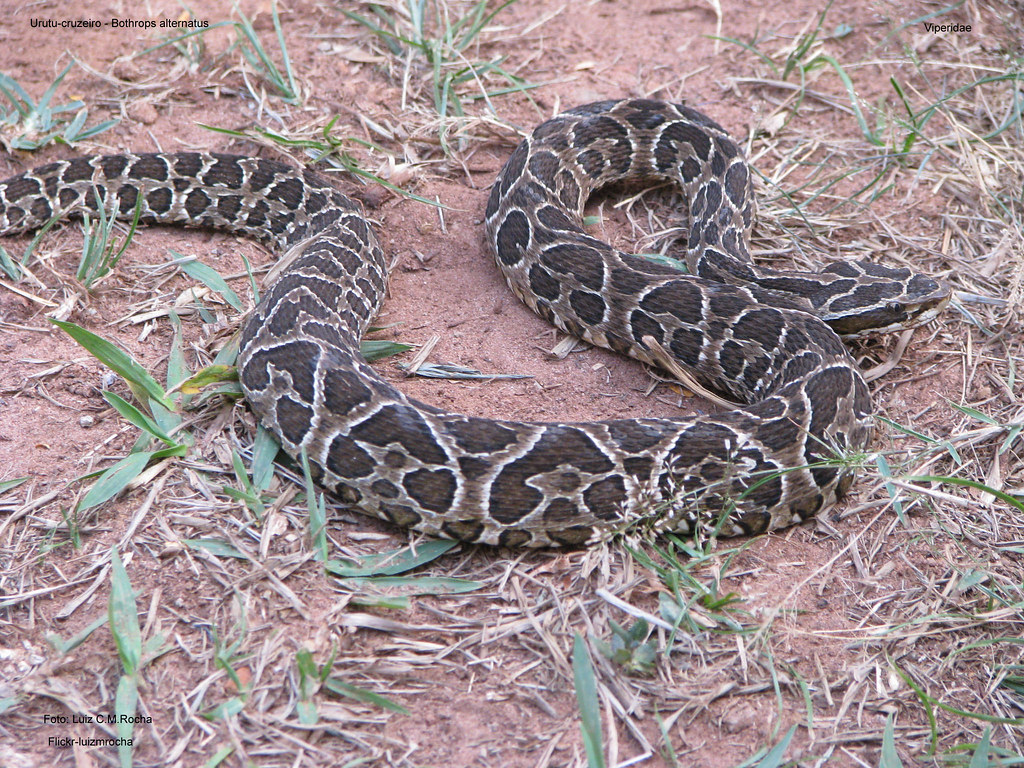
The Urutu is a thick-bodied, ground-dwelling viper found in southern Brazil, Uruguay, Paraguay, and northern Argentina. It wears bold, earthy patterns, cross-like or zigzag bands bordered in light cream, the kind of camouflage that belongs in leaves, soil, and shade.
Adults typically measure between 80 and 120 cm (2.6 to 3.9 ft), but some individuals have reached lengths of up to 169 cm (5.5 ft).
It belongs to the genus Bothrops, among the lanceheads, though some taxonomic revisions have temporarily listed it as Rhinocerophis alternatus. The current consensus places it firmly back within Bothrops.
Here is its current classification:
| Taxonomic Rank | Classification |
|---|---|
| Kingdom | Animalia |
| Phylum | Chordata |
| Class | Reptilia |
| Order | Squamata |
| Family | Viperidae |
| Subfamily | Crotalinae (pit vipers) |
| Genus | Bothrops |
| Species | Bothrops alternatus |
They are ambush predators. They wait. They don’t chase.
This is not a snake that wastes energy.
The Watcher After the Strike
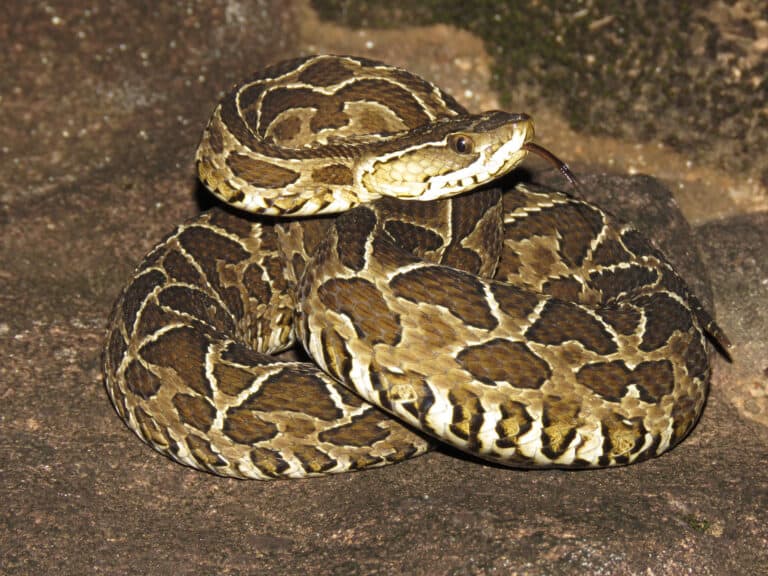
I watched an adult female Urutu strike during a live feeding. One strike, clean, purposeful. Then she backed off. She didn’t chase. She didn’t thrash. She simply watched, checked once or twice to see if the prey was dead, then waited.
The handler said she sometimes strikes twice, but this time, she didn’t need to.
That moment stayed with me. It wasn’t just hunting. It was restraint. It was knowing that power doesn’t need to be repeated to be real.
It belongs to a genus filled with potent vipers, jararacas, fer-de-lances, and lanceheads of every sort. But the Urutu is its own presence.
Common names blur it: fer-de-lance, crossed pit viper, yarará grande. The confusion flattens it. But the snake remains sovereign beneath the shifting labels.
Urutus are viviparous. They give birth to live young, usually between 3 and 12 per litter. These neonates are fully venomous at birth.
There are even unconfirmed whispers of virgin births, parthenogenesis, in captive Urutus. A lone female giving birth without a mate. No paper published yet. But the story holds.
Some snakes come into this world already armed.
Venom and Value
Urutu venom is highly hemolytic and hemotoxic, destroying tissue, rupturing blood vessels, and impairing clotting. It has both procoagulant and anticoagulant effects, a paradox that fascinates researchers. The venom is also cardiotoxic, known to decrease blood pressure, cardiac output, perfusion pressure, and stroke volume. But inside that danger is also value. Researchers have studied its venom for metalloproteinases, phospholipases A2, and platelet inhibitors.
A 100 mg (0.1 g) vial of its venom was valued at $617 at the time of a video recorded three years ago. Not for fear. For medicine.
The Urutu is one of the most medically significant snakes in South America, not because it kills often, but because its venom teaches us how blood and muscle behave under pressure.
I’ve often heard it: “That’s a good snake; it’s not venomous.” But venom is not a flaw. It’s not evil. It’s not the sign of a dangerous soul. Venom is precision. It’s chemistry honed by evolution. It’s a kind of language, speaking in enzymes, proteins, and pressure.
The Urutu’s venom doesn’t just take life. It gives insight. It breaks open the mechanics of clotting, pressure, and pain, offering tools for medicine far beyond antivenom. There is no such thing as a “bad” snake.
Only a misunderstood one.
Reflection: The Bite That Belongs
The more I watch, the more I learn: the Urutu isn’t erratic. It’s exact. It doesn’t seek conflict. It holds its ground.
Its strike is powerful. Its venom is dangerous. This is not a metaphor. It is a biological fact. The Urutu can kill, and it will, when provoked, mishandled, or misplaced.
But danger does not mean disorder. It means precision. It means presence.
This snake evolved for balance within its ecosystem. It belongs to the soil that shaped it, the prey that sustains it, and the predators that respect its space.
Lethal, But Rarely Fatal
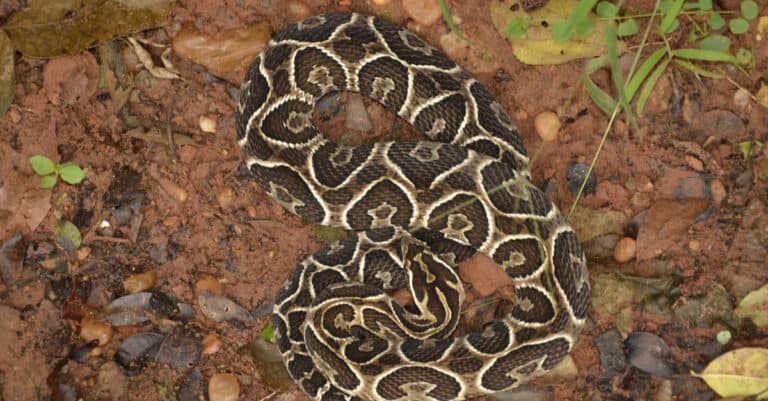
Although the Urutu’s bite is dangerous, fatalities are rare, especially in regions where the snake is native.
Thanks to the ongoing work of herpetologists and venom labs that breed and milk these snakes, effective antivenoms exist. In places like sugarcane fields, where encounters are more frequent, lives are saved not by luck but by preparation and respect.
It does not belong in a home.
It does not belong in a tank as part of a collection to be shown off. Some snakes are not safe in captivity. And some humans are not equipped to share space with any snake at all.
Even the ones we call “safe” are not toys. They are sovereign beings.
Companions, perhaps, but never decorations. Family, sometimes, but never property.
I will always keep snakes, but not as trophies, not as conquests.
I keep those who need keeping. I house the displaced.
And I learn, every day, from the ones who still refuse to be domesticated by the human gaze.
The Urutu reminds me:
Danger is not evil. Stillness is not surrender.
And some beings strike, not out of rage,
But because the boundary has been crossed one time too many.
There is power in choosing the moment. There is wisdom in restraint.
There is sovereignty in the bite that does not miss.
 Book of Kismet
Leave a comment